
Why Not Wall Street?
Writing a thriller with power imbalance, plush carpet, and collateral damage

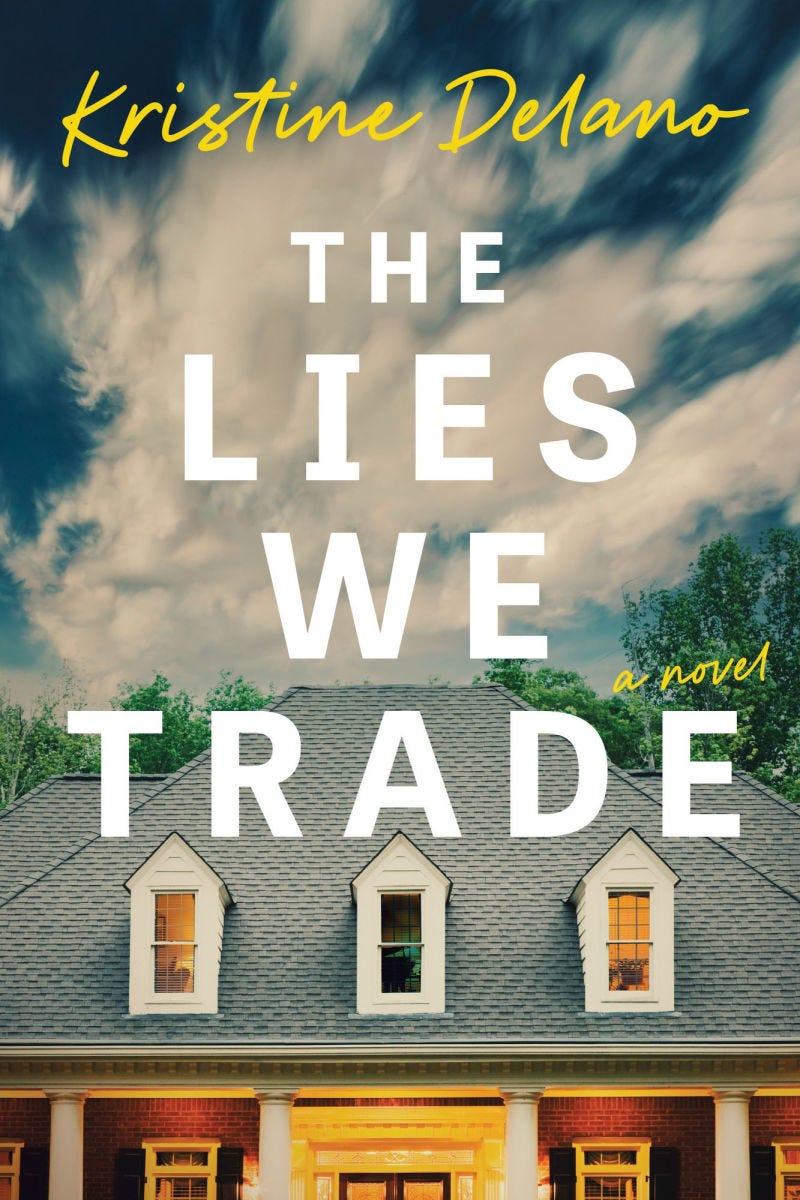
Today we have a guest post from Kristine Delano, former Wall Street executive and author of The Lies We Trade. Kristine and I met by chance in a hotel lobby. I was finishing the second draft of my current novel, and she was meeting with a reporter about the publication of her debut, and I couldn’t stop eavesdropping!
We had a coffee date a couple weeks later, and I eventually read her debut, which held a fascinating mix of domestic suspense and high finance subterfuge. I asked her if she’d write a piece for us on her choice of niche, and happily she did. Enjoy! - Caitlin
Five minutes before my crucial presentation, an executive twice my age and three times as confident pulled me aside. If you know high finance, you know you should never admit a lack of confidence. Impostor syndrome is the kiss of reputational death. But here and now, I’ve agreed to tell you why I write Wall Street thrillers, and to really explain this, I’ve got to be honest about what life was like for the two decades I spent in the game. So, this man—let’s call him Pasty Bald Guy—put his thick fingers on my wrist and steered me away from the table. Not to quietly offer me guidance or to wish me luck. Instead, he said, “Kristine, grab a chair along the wall. I’ll toss it to you when the time’s right.”

Pasty Bald Guy was stealing my presentation. He wanted me to be a wall-dweller. If you haven’t spent the excruciating hours that I have in boardrooms, you might not realize how this shook me. Cold plunge to the chest. I had prepared for weeks to sit amongst the suits and argue for an innovative restructure. My seat was at the table. Period. Full stop. In that mahogany paneled room, with carpet so soft you could curl up on it, my voice was my power. Speaking would be extremely awkward, if not impossible, if I was not at the table and instead a member of the visible-knee clan with my back pressed up against the wainscot.
This moment was Wall Street. Every gesture is a negotiation. Every seat is a battlefield and every meeting a silent opportunity to climb, to survive, or to share the stage without losing relevance. It’s why high finance makes the perfect setting for a thriller, and why I set my novel, The Lies We Trade, squarely in the center of it.
1. Power imbalance is the air Wall Street breathes
Thrillers rely on tension, and there is no tension quite like the silent hierarchy of finance. It’s not just who is in the room but who is allowed to talk. It’s the way a junior analyst’s idea suddenly becomes visionary when echoed by someone with a loftier title.
This is exactly the kind of imbalance that drives The Lies We Trade. Protagonist Meredith isn’t just navigating corporate politics: she’s navigating the delicate ecosystem of unspoken rules, shifting alliances, and hidden agendas. When that mysterious envelope lands in her hands, the question isn’t just What does it mean?
It’s Who benefits? Who is threatened? And who wants her out? Power imbalance is thriller fuel, and Wall Street pumps it out with every trade.
2. High pressure creates organic suspense
Some thrillers require a serial killer, a car chase, or an evil plot from decades past. Wall Street needs none of these. The stakes are already sky-high. In my novel, the mysterious Betsey is brilliant but fragile. She could be a hero, a pawn, or a nightmare depending on her wounds and choices. Wall Street is full of people who fear failure, irrelevance, and at their very core, they fear not being enough. These are the motives that make characters like Hardwin, the older lawyer in The Lies We Trade, so compelling. He’s not twirling a mustache; he’s clinging to an identity, desperate to stay indispensable. Corruption rarely starts with malice. It starts with rationalization.
Thrillers thrive on secrets. Wall Street seeks to expose them. It’s a perfect match.
3. Corporate pressure bleeds into family life and amplifies the stakes
A great thriller doesn’t just put its protagonist at risk professionally. It puts her at risk personally. The demands are relentless, and the emotional cost is real. In The Lies We Trade, Meredith’s high-pressure job strains her marriage, distances her from her daughter, and forces her into impossible choices that follow her home long after the trading day ends.
In The Lies We Trade, the real climax isn’t just about uncovering the truth. It’s about Meredith discovering who she is when the world she built crumbles and her family is threatened.
As an executive who spent more than twenty years navigating a high stakes career, alongside people whose quirks, brilliance, and egos could fill a bookshelf, I can say with absolute certainty: you don’t have to invent drama on Wall Street, you just have to pay attention.
So, what did I do after Pasty Bald Guy tried to relegate me to the wall? First, I quickly read the room. Then I saddled up to Bold Seahorse Tie Guy, who was not the most powerful in the room, but a tight second. I leaned in and shared some quiet intel. He pulled out a chair and I sat. I wasn’t a wall-dweller. Not this time.
Hope you enjoy reading The Lies We Trade. Reach out and let me know. Any guesses on why Bold Seahorse Tie Guy was my mark?
Kristine Delano is a former Wall Street executive turned author of domestic thrillers set in the high-stakes finance world. Her 2026 debut The Lies We Trade hit the ECPA new release best seller list. Her sophomore novel, Forget What You Know, also from Tyndale House, will be out early 2027. Kristine hosts the We Talk Careers podcast and mentors women on work-life balance. When she’s not writing or reading, she enjoys scuba diving with friends or chasing her family down the ski slopes of western Maine.
Kristine pens the Substack, Wall Street Suspense.

PS would love to know the timeline from having that moment, deciding to write a thriller, learning how to write a thriller, leaving your Wall Street job, selling your novel! Huge congrats on your writing career!
First guess in response to your q: because of the tie? His identity included be a little different and seeing himself as a good guy, willing to stick out?